
Review · EPHESUS PRIVATE GUIDED TOURS
Tailor-Made Private Ephesus Tour with Local Experiences
Ephesus is huge; this keeps it manageable. I like the private feel, so you can set the pace, and I like having a licensed English-speaking guide who helps you make sense of what you’re seeing. The one trade-off: major site admission fees are not included, and the Virgin Mary house is set on a hillside with some steep walking.
I also appreciate that this is built for real days: cruise pickup and drop-off work, the ride is in a new A/C Mercedes Vito, and you get a sit-down lunch rather than a snack-and-sprint day. You’ll see the big-name anchors like the Library of Celsus and the Great Theatre, plus the smaller stops that explain how people actually lived and governed in Roman and earlier Greek Ephesus.
This is ideal if you want a “highlights with meaning” Kusadasi cruise excursion—without getting stuck in a long queue for basic entry. If you’re on a tight schedule, you’ll still want to plan your budget for entrance tickets (even though you’ll get skip-the-line handling for sites that charge).
In This Review
- Key points to know before you go
- Private Ephesus Tour from Kusadasi: Why this order works
- Price and logistics: What you pay $75 for (and what you don’t)
- A/C Mercedes van and pickup that actually matches cruise days
- House of the Virgin Mary on Bulbul Mountain: calm views, steep paths
- Entering Ancient Ephesus: the city in one long walking thread
- State Agora and Odeion: where politics met daily life
- State Agora
- Odeion
- Emperor temples on Curetes Street: Hadrian and Domitian up close
- Temple of Hadrian
- Temple of Domitian
- Hercules Gate: when the city turned pedestrian
- Terrace Houses and Celsus Library: mosaics, family life, and 12,000 scroll vibes
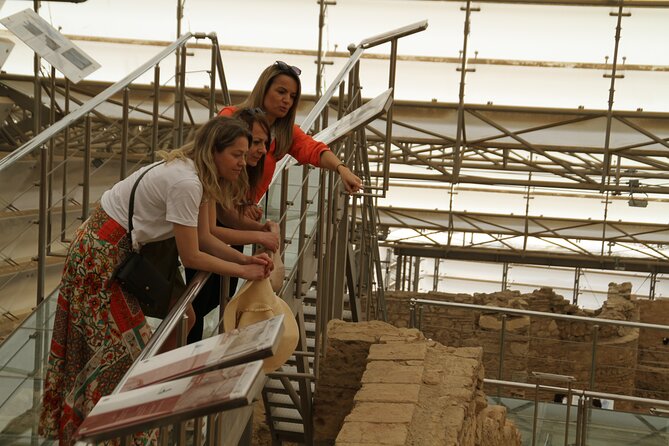
- Ephesus Terrace Houses
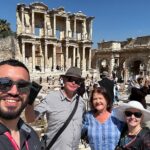
- Library of Celsus
- Great Theatre and Basilica of St. John: public spectacle and spiritual roots
- Ephesus Great Theatre
- Basilica of St. John
- Temple of Artemis, Okuz Mehmet Pasa caravanserai, and Kusadasi bazaar time
- Temple of Artemis (free admission)
- Okuz Mehmet Pasa KervansarayI (free admission)
- Kusadasi Bazaar (free time)
- Lunch and shopping: a good break with one watch-out
- Who this tour suits best (and who should think twice)
- Should you book this Tailor-Made Ephesus Tour?
- FAQ
- How long is the private Ephesus tour?
- Is this a private tour?
- Does the tour include pickup and drop-off?
- What language is the guide?
- Are admission tickets included in the price?
- Is skip-the-line entry included?
- What’s included in lunch?
- Is there time to shop at the end?
- Can I cancel for a full refund?
Key points to know before you go
- Private, not pushy: Your guide can adjust pacing and priorities during the day.
- English guide with context: Stops connect into one story, from faith to emperors to daily life.
- Skip-the-line tickets included: You handle fewer hours waiting at ticket counters.
- A steep start at the House of the Virgin Mary: Expect hillside paths and stairs.
- Lunch is part of the value: Usually a local meal with time to breathe between ruins.
- You cover more than ruins: Agora buildings, emperor temples, a caravanserai, and Kusadasi bazaar time.
Private Ephesus Tour from Kusadasi: Why this order works
If you’ve ever tried to “DIY” Ephesus, you know the problem: you spend more time figuring out logistics than understanding the place. This tour solves that by grouping stops so they build one mental map. You start with the spiritual layers (the House of the Virgin Mary), then move into the Roman/Greek city core (Ancient Ephesus), then finish with architecture that shows power and public life (the theatre, emperor temples), and later add Ottoman-era texture (the caravanserai) plus a taste of modern Kusadasi shopping.
The private format matters more than people think. The guides on this experience—names like Gökçe, Tas, Nagi, Asli, Selin, Ahmet, and Tailan show up frequently—are focused on how your day feels. Multiple guide reviews highlight that you don’t get rushed, and that questions are welcome without turning the day into a lecture.
The duration runs about 6 to 8 hours, which is long enough to see the highlights, but still short enough to keep energy. That timing also makes sense for cruise schedules, where a bad day plan can turn into stress.
Your own guide and car, more private Ephesus days
- FOR CRUISERS: Skip The Lines PRIVATE EPHESUS TOUR &On Time Return
★ 5.0 · 8,527 reviews - PRIVATE EPHESUS TOUR FOR CRUISERS: On-time Return and Skip-Line
★ 5.0 · 5,807 reviews - PRIVATE NO HIDDEN FEES Ephesus, Mary’s House Guided Tour /GRP OPT
★ 5.0 · 2,455 reviews - For Ship Guests:BEST SELLER EPHESUS PRIVATE TOUR & On Time Return
★ 5.0 · 2,029 reviews
Price and logistics: What you pay $75 for (and what you don’t)
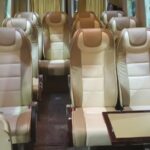
The headline price is $75 per person. That’s the part that covers the human and the ride: a professional licensed English guide, pickup and drop-off for cruise guests, a new A/C Mercedes Vito with a private driver, a local lunch, and guaranteed skip-the-line tickets.
Here’s the trade you should plan for: the biggest ruin sites charge admission on top of the $75. Based on the listed fees, you should budget roughly:
- Ephesus Ancient City: €40
- House of the Virgin Mary: €18
- Ephesus Terrace Houses: €15
- Basilica of St. John: €6
Temple of Artemis is listed as free, and the caravanserai is free too.
So is it good value? For most people, yes—because the day is packed with meaningful stops and you’re not paying for a driver-less taxi scramble. Plus, skip-the-line planning helps when you want to spend your time looking at the stones instead of waiting behind a rope and a ticket counter.
A/C Mercedes van and pickup that actually matches cruise days
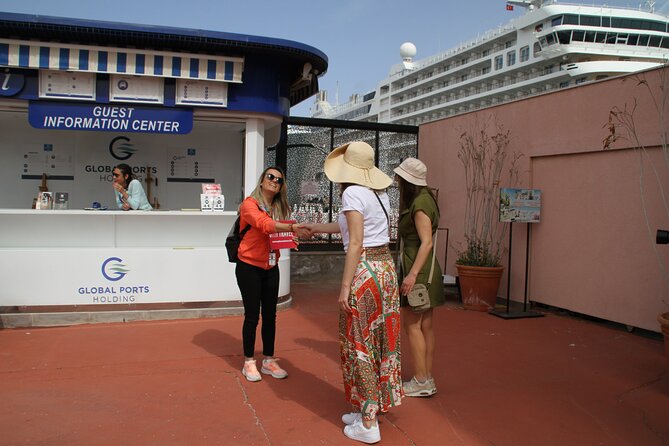
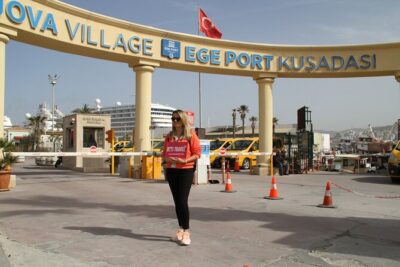
This is one of those details that separates a smooth excursion from a stressful one. Cruise passengers meet at the exit gate of the immigration terminal of the Kusadasi cruise port, with an OTTI Travel sign. Then you’re picked up and handled by the guide and driver for the day, ending with drop-off back where you need to be.
For hotel pickup in Kusadasi, you meet the guide at the hotel reception. For Izmir airport (ADB) pickup, you meet at the exit gate of the domestic terminal with an OTTI Travel sign.
In plain terms: you’re not wandering the port trying to find your group. You’re met, loaded into a modern vehicle, and then you focus on Ephesus.
House of the Virgin Mary on Bulbul Mountain: calm views, steep paths
The House of the Virgin Mary is set high on the Bulbul mountain, about 9 km ahead of Ephesus. The site is quiet and green, tucked away from the main hustle. It’s built with Roman-style stone, and in the 4th century a church combining Mary’s house and grave was built. The layout includes rooms you might recognize from different traditions: an anteroom area (today associated with candle offerings), a bedroom/prayer space, and a fireplace room that functions as a chapel for Muslims.
The key practical point: you’re going up and down paths. The tour explicitly calls for moderate physical fitness. In real terms, that means if you have mobility limits, plan for stairs and uneven or steep sections. One review specifically mentions the driver helping a mother with hip issues by adjusting how close the vehicle can get, so ask your guide what’s possible once you’re there.
Time on this stop is about 45 minutes. That’s long enough to take photos, sit with the atmosphere, and then shift gears into the louder, bigger Ephesus ruins.
Entering Ancient Ephesus: the city in one long walking thread
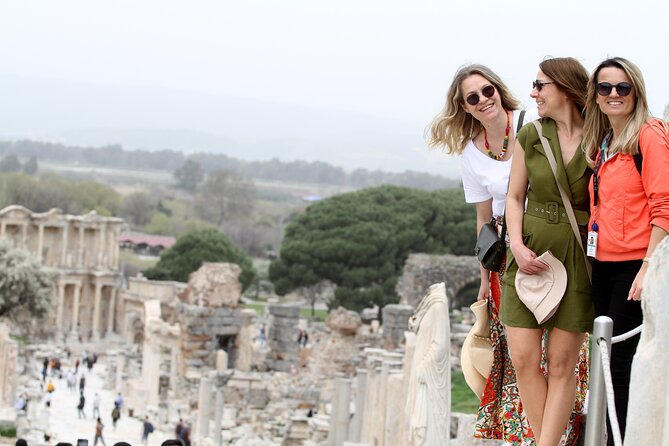
Then you move into Ephesus Ancient City, where the stone tells a timeline. This place is the setting for multiple “eras at once” moments: Greeks, then Romans, then later centuries that reused and reshaped older spaces.
You’ll hear the major anchor story: in 356 BC, the Greeks built the Artemesium (a colossal Ionic temple for Artemis). Later, during the 2nd century BC, Ephesus became a major city—famous for the Artemision Temple, the Library of Celsus, and even a medical school.
In a highlights day, the goal is not to read every sign. It’s to stand where the city’s ideas show up:
- Public institutions and meeting spaces (Agora and Odeion)
- Emperor-focused architecture (temple dedications)
- Cultural life and spectacles (theatre)
- Faith and community (St. John Basilica)
This stop runs about 1 hour 30 minutes. With a private guide, you can spend a little more time on the parts that click for you and let the rest move by without feeling lost.
State Agora and Odeion: where politics met daily life
Most people only think of Ephesus as temples and theatres. This tour also pulls you into the “how the city worked” spaces.
State Agora
The State Agora was built in the Roman period in the 1st century BC. This wasn’t a trading square for goods—it was used for governmental business and discussion. During excavations, archaeologists found graves from the 7th–6th centuries BC in the northeastern corner, plus a stone-paved road and an archaic terra cotta sarcophagus. The clue here is the city didn’t just build once; it reused ground and changed functions over centuries.
There’s also a water reservoir at the corner of the Agora, with water brought through the Pollio Aqueduct. Even the mention of the aqueduct matters: it reminds you that “ruins” are often the visible shell of a full infrastructure system.
Odeion
Next is the Odeion, a small theatre-like structure with stage building and seating. It had a double function: it served as a Bouleuterion (for meetings of the senate/councils) and also as an Odeum concert hall for performances. It was constructed in the 2nd century AD by Publius Vedius Antonius and his wife Flavia Paiana. It could hold about 1,500 spectators.
You’ll spend only about 15 minutes here, so the guide’s job is to point out what makes it different from a “plain theatre.” Think: this is civic power in architecture form, not just entertainment.
Emperor temples on Curetes Street: Hadrian and Domitian up close
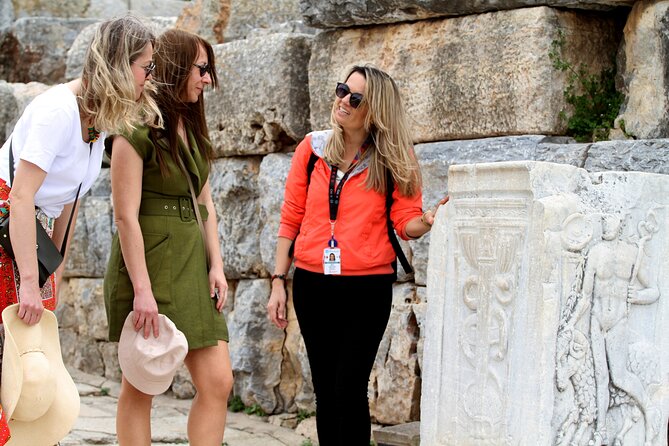
Walking along Curetes Street, you hit two big statements of Roman authority.
Temple of Hadrian
The Temple of Hadrian is one of the best-preserved structures on Curetes Street. Built before 138 AD by P. Quintilius, it was dedicated to Emperor Hadrian, who visited in 128 AD. The facade features four Corinthian columns and a curved arch, with a relief of Tyche (goddess of victory) in the center. Side columns are square. Inscriptions at the pedestal relate to emperor statues between 293–305 CE (Diocletian, Maximian, Constantius I, and Galerius). Originals aren’t found, but the context is part of the story.
This stop is short—about 10 minutes—but it’s worth it because it shows the “why” of the street layout: public space used to celebrate and enforce power.
Temple of Domitian
The Temple of Domitian sits at the south end of Domitian Street and is the first known structure in Ephesus dedicated to an emperor. It stands on a high terrace (about 50×100 meters) with vaulted foundations and visible stairs. The pro-style plan includes eight columns on the short side and thirteen on the long side, plus four additional columns in front of the cella. There was also a U-shaped altar (now displayed at the Izmir Museum).
One concept the guide helps you connect: during Domitian’s reign, Ephesus gained permission to build an Emperor Temple—its first “neocoros.” It’s basically the city earning the honor and the right to promote imperial worship.
Hercules Gate: when the city turned pedestrian
Near the end of Curetes Street you’ll reach Hercules Gate. The gate gets its name from a relief of Hercules. It was moved to its current location in the 4th century AD, but the relief itself dates to the 2nd century AD. Today, only two sides of the columns remain, so you won’t get a full “gate moment” the way you might in a restored ruin.
Still, the location matters. The gate narrowed access to the street and helped block vehicles—by the 4th century, the street functioned as a pedestrian area. That’s one of those details that makes you feel the city evolving: from broad civic movement to controlled, human-scale flow.
Terrace Houses and Celsus Library: mosaics, family life, and 12,000 scroll vibes
If you like the idea that history includes everyday people—not just emperors—this section is for you.
Ephesus Terrace Houses
The Terrace Houses sit on a hill opposite the Hadrian Temple, sometimes described as the homes of wealthy Romans. They were built using the Hippodamian city plan with right-angle road grids. Six residential units span three terraces along the Bulbul Mountain slope. The oldest building dates to the 1st century BC, and they were lived in until around the 7th century AD.
The structures have protective roofing that resembles Roman houses, and mosaics and frescoes were consolidated. Two houses are opened as a museum. Time here is about 30 minutes, which is just enough to see the “why people loved these homes” without feeling like you need to become an archaeologist.
Library of Celsus
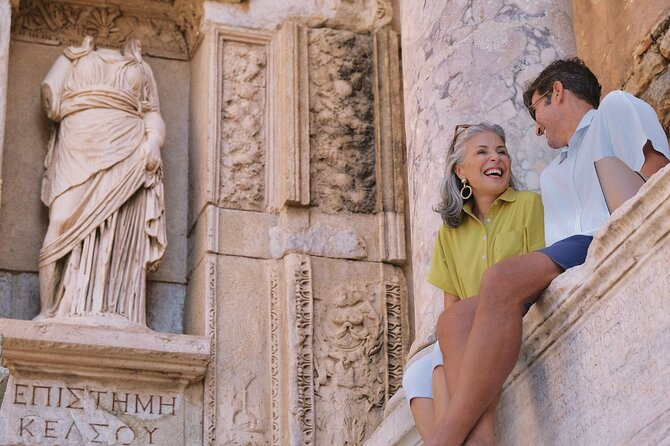
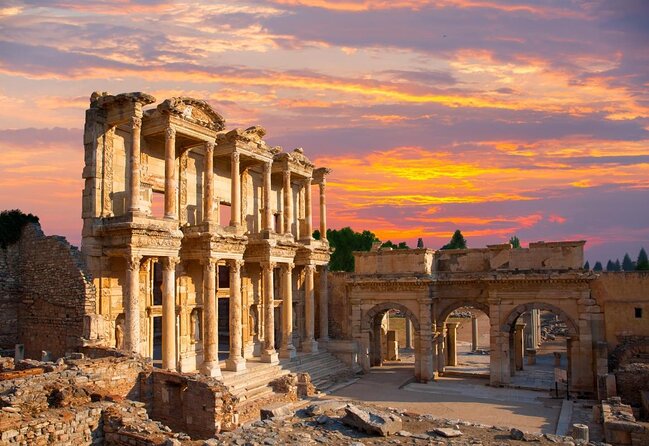
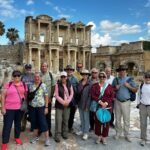
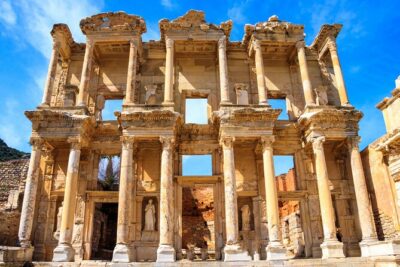
Then comes the classic photo stop: the Library of Celsus, built in 117 AD as a monumental tomb for Gaius Julius Celsus Polemaeanus, governor of the province of Asia, commissioned by his son Galius Julius Aquila. You’ll learn that the grave sits beneath the ground floor, behind the entrance, and there’s a statue of Athena over it.
The mechanics are what make this building feel smart. Scrolls were stored in niches along the walls, behind double walls to protect manuscripts from temperature and humidity extremes. The library held more than 12,000 scrolls, and was said to be among the richest libraries of the ancient world.
This stop is about 15 minutes. In that short window, you want to notice the building design that makes storage and memory into architecture.
Great Theatre and Basilica of St. John: public spectacle and spiritual roots
The tour keeps moving between crowd-sized space and more sacred storytelling.
Ephesus Great Theatre
The Ephesus Great Theatre is the biggest in Anatolia, with a capacity of about 25,000. It first started in the Hellenistic period (3rd century BC), then Roman leaders enlarged it into the form you see today. The seating has 66 rows, with walkways (diazomata) dividing it into three sections. You might spot restoration marble pieces and an emperor’s box in the lower area.
This theatre also had multiple uses beyond plays: religious and philosophical discussions, political gatherings, and even animal and gladiator fights. The guide’s context is what helps you picture that roar and motion rather than just “stone steps.”
Time here is about 15 minutes.
Basilica of St. John
Then you head to the Basilica of St. John. Tradition holds that the evangelist John spent his last years around Ephesus and was buried on the southern slope of Ayosolug Hill. A small chapel over the grave appeared in the 4th century, and the church became a basilica during the reign of Emperor Justinian in the 6th century (527–565 AD).
You’ll also connect the site to early Christian persecution and the later Roman story of Paul, Stephen, and James. Tradition links John arriving with Mary and writing the Gospel in Ephesus and Revelation on Patmos around 96 AD.
This stop is longer—about 30 minutes—and it benefits from a slower pace since it’s a place people often feel more than analyze.
Temple of Artemis, Okuz Mehmet Pasa caravanserai, and Kusadasi bazaar time
You finish with variety so your brain doesn’t burn out on only one era.
Temple of Artemis (free admission)
The Temple of Artemis is one of the Seven Wonders of the ancient world. It was built on an area that later turned into a swamp, so what you see now is mainly foundations. Marble remains are still impressive, but much of the most beautiful stonework was transported and displayed elsewhere (the British Museum is specifically referenced).
This stop runs about 25 minutes, and the admission is listed as free.
Okuz Mehmet Pasa KervansarayI (free admission)
Next is the Okuz Mehmet Pasa KervansarayI, built between 1615 and 1618 under Öküz Mehmed Pasha, who served as Governor of Ottoman Egypt and Grand Vizier. It was built in a fortress-like style to fit the needs of the time and functioned as a customshouse. Renovation happened in the mid-20th century (1954–1966), and the financial details are listed, including that the renovation cost was about ₺2.1 million (approx US$0.21 million).
Time here is short—about 10 minutes—but it’s a nice reminder that travel history didn’t start with Romans. Trade routes and caravans shaped the region too.
Kusadasi Bazaar (free time)
Finally you get around 1 hour of free time in Kusadasi’s bazaar area. It’s a huge market with lots of shop types—Turkish goods, leather, sweets, knick-knacks, and the usual souvenir-heavy items. The practical move is simple: set your budget before you walk in, and decide early if you want to browse or buy.
Lunch and shopping: a good break with one watch-out
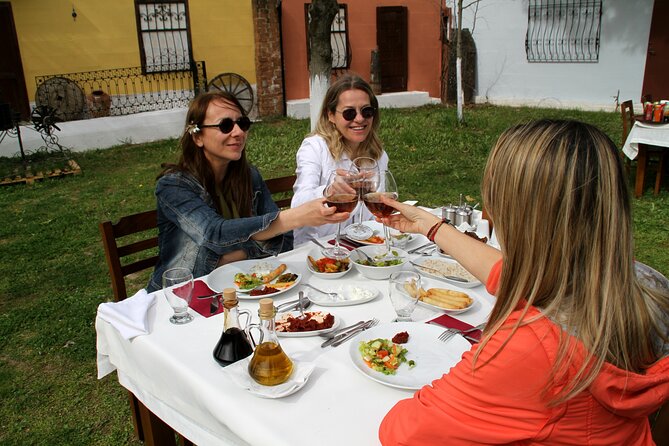
Lunch is included, and it’s meant to keep the day humane. Alcoholic drinks are not included, so if you want beer or wine, plan on paying separately.
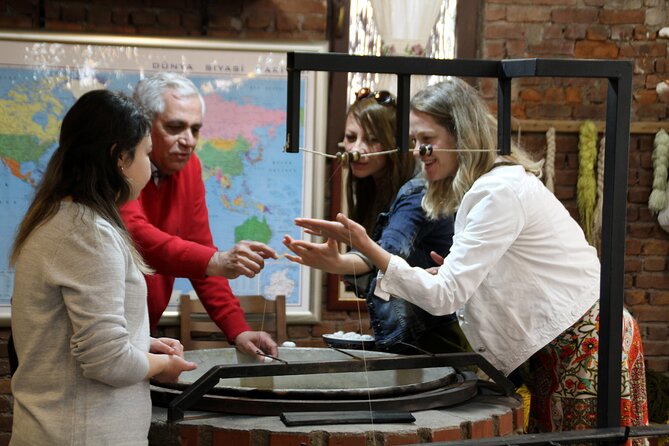
One recurring detail from the experience is that lunch can be paired with a carpet weaving or related craft presentation. Some days, it’s described as a cooperative and student-focused learning moment; other days, it can feel like a sales push if you’re not interested in rugs. The best way to handle this is direct: tell your guide you’re not shopping for rugs, and ask for the craft demo to be short. In multiple cases, guides adjusted the day to match preferences, including skipping or changing stops last minute.
Who this tour suits best (and who should think twice)
This is a strong fit if:
- You want a private Ephesus tour from Kusadasi with a licensed English guide.
- You care about understanding how the sites link—Agora to theatre to emperor temples to the spiritual story.
- You want a day that can flex with your energy level and interests.
It’s less ideal if:
- You hate walking on hills. The House of the Virgin Mary is set on a mountain and can include steep paths and stairs.
- You don’t want to pay site admissions on top of the base price. Artemis and the caravanserai are free, but several major stops require extra fees.
If you’re a family, couples, or history-minded solo traveler, you’ll probably love the pacing. If your group wants an all-day theme park style rush, a guided historical flow might feel more “walk and think” than “see and sprint.”
Should you book this Tailor-Made Ephesus Tour?
I’d book it if you’re coming from a cruise port and you want Ephesus without the stress of self-planning. The blend of a modern air-conditioned vehicle, licensed English guidance, lunch included, and skip-the-line handling makes it feel like you’re paying for a smooth, thoughtful day—not just a ride.
If you do book, do these two things:
- Budget for entrance fees up front, and keep some cash or card ready for on-site payments.
- Tell your guide what you want to avoid, especially anything involving shopping at craft stops. Guides have shown they can adjust when you’re clear.
If your goal is to see Ephesus as more than a pile of ruins, this tour is a practical way to do it.
FAQ
How long is the private Ephesus tour?
It runs about 6 to 8 hours, depending on the day’s flow and how long you want at each stop.
Is this a private tour?
Yes. It’s private, and only your group participates.
Does the tour include pickup and drop-off?
Yes. Cruise passengers are picked up at the exit gate of the immigration terminal of the Kusadasi cruise port (with an OTTI Travel sign). Hotel pickup is at the hotel reception, and airport pickup is at the exit gate of the domestic terminal at Izmir (ADB) with an OTTI Travel sign.
What language is the guide?
The guide is a professional licensed English-speaking tour guide.
Are admission tickets included in the price?
No. The listed admission fees for Ephesus Ancient City, House of the Virgin Mary, Terrace Houses, and the St John Basilica are not included. Temple of Artemis and the caravanserai are listed as free.
Is skip-the-line entry included?
Yes. Guaranteed skip-the-line tickets are included.
What’s included in lunch?
A delicious local lunch is included. Alcoholic beverages and drinks at lunch are not included.
Is there time to shop at the end?
Yes. You get about 1 hour of free time at the Kusadasi bazaar.
Can I cancel for a full refund?
Yes. You can cancel up to 24 hours in advance for a full refund. If you cancel less than 24 hours before the start time, the amount paid is not refunded.
The Rest of the Shortlist
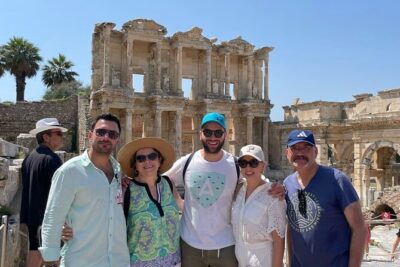
Ephesus, Just Your Party
Just Added Around Kusadasi
- Ephesus and House of Mary from Kusadasi Cruise Port★ 4.0 · 3 reviews
- Ephesus: 4-Hour Guided Tour with Transfer from Kusadasi★ 5.0 · 3 reviews
- Sirince Village & Selcuk Bazaar Tour From Kusadasi★ 4.5 · 3 reviews
- FOR CRUISERS: Best of Ephesus Tour with GUARANTEED ON-TIME RETURN★ 5.0 · 3 reviews
- Shore Excursion: Private Pamukkale Tour From Kusadasi Port★ 5.0 · 3 reviews
- For Cruisers: Ancient Ephesus Private Tour From Kusadasi Port★ 5.0 · 3 reviews
Ephesus Private Guided Tours, compared.
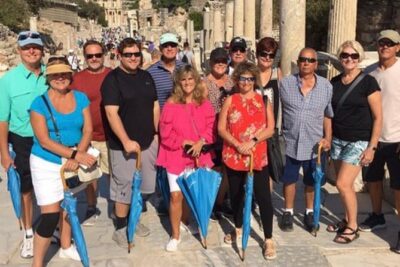 ★ 5.0FOR CRUISERS: Skip The Lines PRIVATE EPHESUS TOUR &On Time ReturnFrom $398,527 reviews
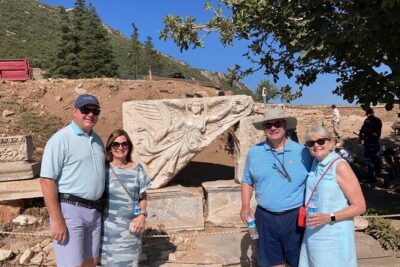 ★ 5.0PRIVATE EPHESUS TOUR FOR CRUISERS: On-time Return and Skip-LineFrom $295,807 reviews
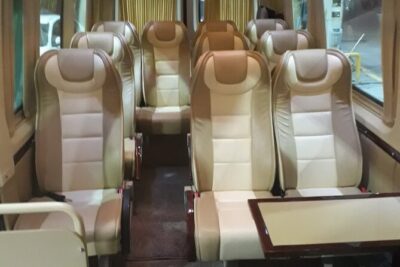 ★ 5.0PRIVATE NO HIDDEN FEES Ephesus, Mary’s House Guided Tour /GRP OPTFrom $992,455 reviews
 ★ 5.0For Ship Guests:BEST SELLER EPHESUS PRIVATE TOUR & On Time ReturnFrom $392,029 reviews
 ★ 5.0Ephesus Temple of Artemis and House of Mary Private Half Day TourFrom $151,573 reviews
 ★ 5.0PRIVATE TOUR FOR CRUISERS: Mary’s House (Meryemana) and EphesusFrom $291,349 reviews
 ★ 5.0SKIP-THE-LINE: Group & Private Ephesus Tour ENTRY FEE & LUNCHFrom $7935 reviews
 ★ 5.0All Inclusive Private Access Ephesus Tour (SKIP-THE-LINE)From $67843 reviews
Browse the lists this tour appears in