
Review · HOUSE OF THE VIRGIN MARY TOURS
Kusadasi Shore Excursion: Private Tour to Ephesus including House of Virgin Mary and Temple of Artemis
Ephesus gets serious when you’re on a deadline. This private Kusadasi shore excursion strings together the Roman city of Ephesus, the House of the Virgin Mary, and the Temple of Artemis in about four hours—so you can actually see the big stuff without turning your port day into a marathon.
Two things I really like: first, the mix of stops gives you both the civic Roman side (the main ruins) and the quieter spiritual side (Meryemana). Second, with a private guide you get practical pacing—slower where it matters, photo time where you want it, and history explained in plain language by locals like Emre or Alex.
One drawback to plan for: the walking is real. Even though it’s managed with a guide’s pacing, Ephesus is downhill and uneven, so wear good shoes and expect some stairs and stone surfaces.
In This Review
- Key things to know before you go
- From Kusadasi to Ephesus: starting at Magnesia Gate
- Ephesus on foot: what you’ll actually see and why it clicks
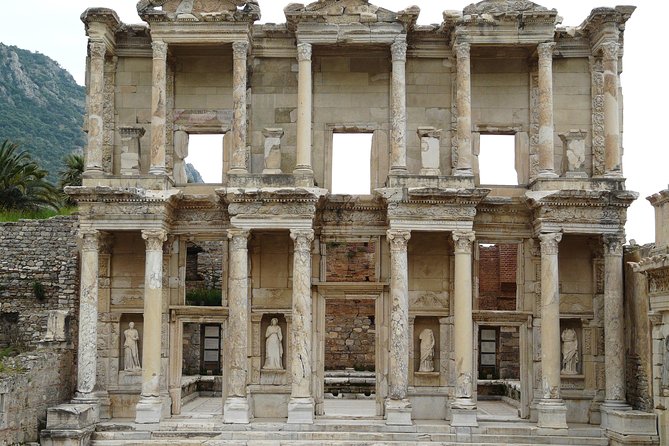
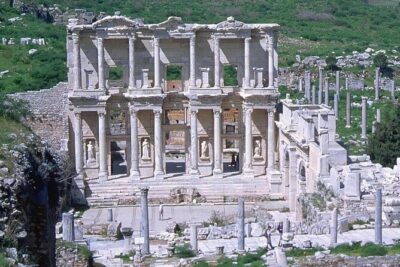
- Celsus Library: the monument that explains the city’s brain
- Odeon and the rhythm of public life
- Great Theater: 24,000 seats and a story tied to St. Paul
- Fountain of Trajan: a Roman city needs water and power
- Temple of Hadrian and the myth panels: a short stop with meaning
- Meryemana (House of the Virgin Mary): what to expect at the small, quiet shrine
- Temple of Artemis ruins: seeing one of the Seven Wonders in fragments
- Private-guide value on a cruise day: pace, shade, and communication
- Price and ticket reality: where the money goes
- Should you book this Kusadasi private tour to Ephesus?
- FAQ
- What’s the duration of the Kusadasi private tour to Ephesus, Mary’s House, and Artemis?
- Where do we meet for the tour?
- Are admission tickets included for Ephesus, the House of the Virgin Mary, and the Temple of Artemis?
- Does the tour offer pickup?
- Is this tour private?
- Is the tour suitable for children?
- How does the worry-free guarantee work if my ship timing changes?
Key things to know before you go
- Private port-day timing: built to get you back to Kusadasi with your ship schedule in mind
- Meet at Magnesia Gate: you start your Ephesus walk in the same place that once functioned as a grand gateway
- Celsus Library + Great Theater in one route: the tour lines up the most photo-worthy ruins efficiently
- House of the Virgin Mary (Meryemana): you’ll learn the Vatican-recognized story tied to a small two-story home in the Solmissos Mountains area
- Temple of Artemis: short stop, huge payoff for seeing one of the Seven Wonders’ ruins
- Optional extra shopping time can appear: many guides include rug and leather demonstrations if time allows
From Kusadasi to Ephesus: starting at Magnesia Gate
Port days in Turkey can feel like a sprint, but this tour is set up to work with that reality. You’ll meet your guide near the harbor (the tour specifies a meet in the area connected to Magnesia Gate). Then you ride by private vehicle to the Ephesus side and start right where the ancient city’s story begins.
Magnesia Gate matters because it’s not just a landmark. It was one of the key city gateways, built to connect Ephesus with Magnesia. That means your walk isn’t starting in the middle of nowhere. You begin in a place designed for movement—chariots, horses, traders, people heading in and out—so the ruins feel like a working city instead of random columns.
If your priority is “see it fast, see it right,” this is a smart approach. A private setup also helps when your ship docking time doesn’t line up neatly with big group tours.
Practical tip: book a meeting/pickup time that matches your ship’s disembarkation window. The tour is listed with operating hours from 8:00 AM to 4:00 PM, so your timing choice matters more than usual.
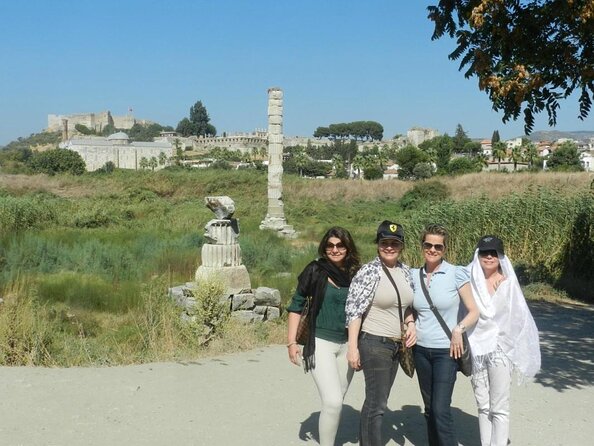
One lone column left standing, more trips past the Artemision
- Ephesus Temple of Artemis and House of Mary Private Half Day Tour
★ 5.0 · 1,573 reviews - Ephesus and Temple of Artemis Private Tour from Kusadasi Port
★ 5.0 · 672 reviews - SKIP-THE-LINE: Group or Private Ephesus & Artemis Tour with LUNCH
★ 5.0 · 462 reviews - From Kusadasi: Ephesus, Mary’s House, and Artemis Tour
★ 4.8 · 234 reviews
Ephesus on foot: what you’ll actually see and why it clicks
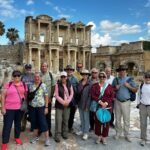
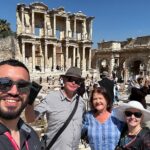
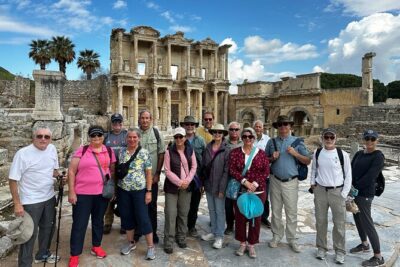
Your main stop is Ephesus, and the route is built around the most recognizable anchors: Celsus Library, the Great Theater, and Roman public spaces you can still picture in your head even after 2,000 years.
The walk starts downhill. That sounds minor until you’re on stone steps in the midday sun. For me, the key value of having a guide (rather than free time) is that they can adjust pace in real time. In multiple experiences with guides such as Eman and Emray, the pattern is the same: keep the group comfortable, find shade when possible, and keep commentary moving so you don’t spend your energy hunting for context.
Here’s the Ephesus sequence you’ll experience and what to watch for at each point:
Celsus Library: the monument that explains the city’s brain
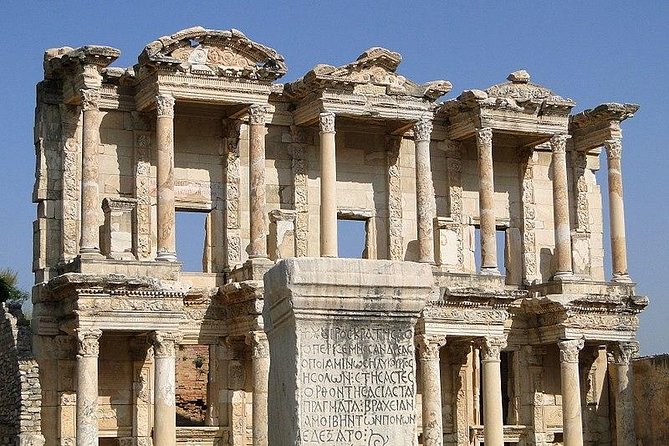
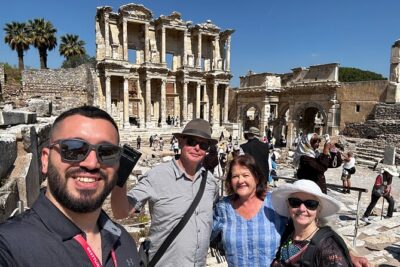
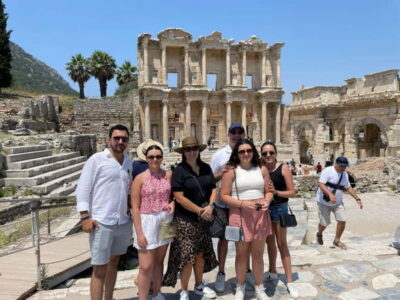
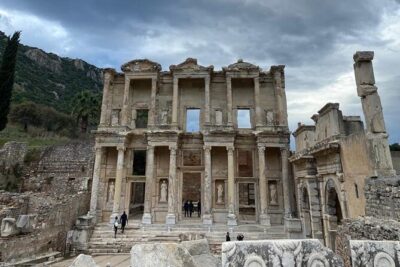
At Celsus Library, you’ll learn why this building was so important. It once housed more than 12,000 scrolls, which is an eye-opener. This isn’t “pretty ruins” territory. This is where knowledge was stored and displayed as a public statement.
If you like history you can see, Celsus is a strong stop because the structure still helps you picture how information moved through the Roman province of Asia.
Odeon and the rhythm of public life
You’ll also pass the Odeon, an important part of how Ephesus kept culture and community in motion. Even if you don’t linger, the stop helps connect the big theater with smaller performance and civic traditions.
Great Theater: 24,000 seats and a story tied to St. Paul
Then comes the Great Theater. The seating is listed as 24,000, and that scale changes everything. From that perspective, it makes sense why speakers, ceremonies, and large gatherings would define a city’s life.
The tour includes the point that the theater is believed to be connected to St. Paul preaching to the Ephesians, and today it’s used for local spring festival events. That blend of “ancient belief” and “modern use of the same space” is part of why Ephesus feels less dead than you expect.
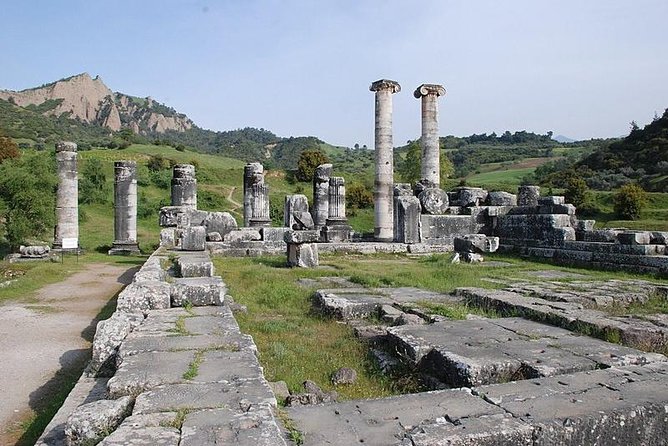
Up the hill to Meryemana, more tours that call there

Fountain of Trajan: a Roman city needs water and power
The Fountain of Trajan is one of those stops that helps you understand how daily life worked. In Roman cities, fountains weren’t just decoration. They were proof of engineering and civic priorities.
If you’re the kind of person who likes to picture what people actually did during the day, this is the kind of ruin that helps you shift from sightseeing to imagining routines.
Temple of Hadrian and the myth panels: a short stop with meaning
After the headline structures, the tour keeps moving through other Roman layers. You’ll visit the Temple of Hadrian and you’ll also be shown the Ephesus foundation with three support panels featuring mythological imagery.
This isn’t the longest stop on paper, but it’s useful. Temples and foundations like this help you see how mythology, politics, and civic identity were tied together. You’re not just looking at a building. You’re seeing how a Roman city used stories to explain itself.
If you tend to ignore “secondary” ruins, don’t skip this moment on a private tour. A good guide can turn it into a quick, satisfying piece of the puzzle—especially when time is limited.
Meryemana (House of the Virgin Mary): what to expect at the small, quiet shrine
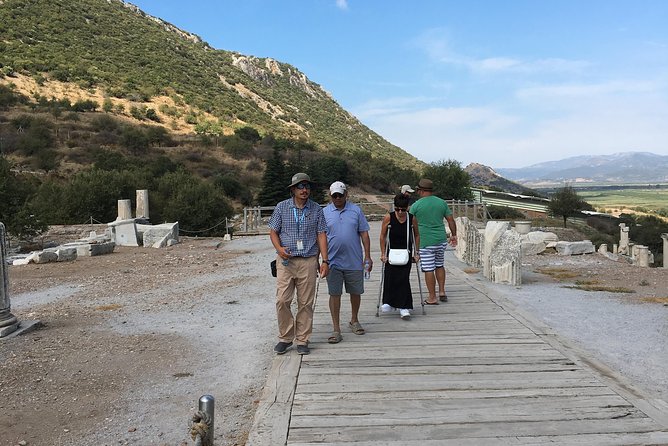
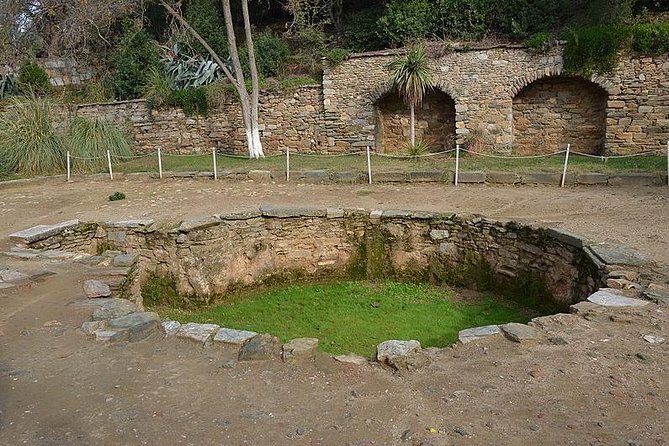
Next you’ll head to Meryemana, also called the House of the Virgin Mary. The tour frames it as the place where Mary spent her final moments. It also notes that the Vatican recognized the small house in the Solmissos Mountains area as the final resting place, and that a shrine was found after discovery of the house ruins.
What I like about this stop is the emotional tone shift. Ephesus is huge, public, and loud by nature. Meryemana is small and personal—two-story, Roman house style—and that contrast is exactly what makes the whole half-day work.
The tour experience includes guidance on what to look for:
- the way the central section is explained in the context of the shrine’s significance
- the right-side room near the altar area, which the tour notes can give the building a more church-like feel than a simple home
Timing is also tight here (the listed stop is short). The real win is arriving with your guide, who can keep you from wandering for context.
Footing note: the house area is typically less chaotic than a major city ruin, but you still need to move carefully. You’ll be outside, and surfaces can be uneven.
Temple of Artemis ruins: seeing one of the Seven Wonders in fragments
Then you’ll get to Temple of Artemis. The tour notes it was first built in the Archaic period, and today you’re looking at ruins—still impressive, still dramatic, still worth your time.
Even in broken form, Artemis reads as “big idea.” It’s one of the Seven Wonders of the Ancient World, and that matters because it sets a scale for Ephesus beyond its local fame. This temple isn’t just about one city’s pride. It’s about the way ancient cultures competed for attention and prestige.
Your stop is listed as short, so treat it like a photo-and-orientation window:
- Look for what remains of the structure’s engineering
- Take a moment to mentally reconstruct the full temple from angles your guide suggests
- Use the guide’s explanations to connect Artemis to what you saw earlier in Ephesus (public space, power, and civic identity)
Private-guide value on a cruise day: pace, shade, and communication
If you’re doing a port excursion, your biggest hidden cost is stress. This private format helps reduce it.
A lot of the strongest experiences in your provided tour info revolve around guides who keep things clear and human. Names that appear include Tay, Amry, Amry/Emry, Inan, Eman, and Hiluk, plus Alex and Emre. The common threads: they guide the route at a comfortable pace, keep you oriented, and help you avoid feeling dragged from stop to stop.
One practical detail I also think you’ll appreciate: shade management. In several accounts, guides are described as keeping people out of the sun when possible, including using umbrellas in some cases. With Ephesus, that kind of care isn’t “extra.” It’s the difference between enjoying the day and feeling cooked.
Also, private often means better communication. If you care about asking questions, this tour style gives you space to do it without holding up a large group.
One caution: not every guide will match your expectation for depth. A couple experiences mention faster pacing with limited commentary or a hard-to-understand English level. Your best protection is choosing this tour type (private) and, if possible, confirming your language preference at booking.
Price and ticket reality: where the money goes
At $422.97 per person for this private tour, you’re paying for three things:
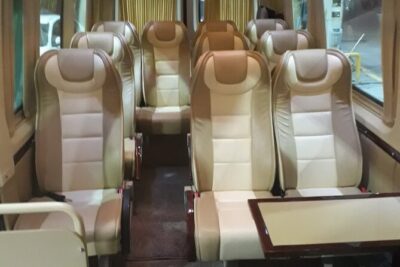
1) a dedicated vehicle and driver
2) a professional guide
3) the port-focused worry-free promise
Is it expensive? Yes, compared with cruise-bus group tours. But this isn’t just “skip the line.” You’re buying a schedule that works, plus expert time inside Ephesus itself (where half a day can evaporate fast if you’re figuring things out on your own).
Two big value anchors:
- Admission tickets aren’t included for the main stops. So budget extra for whatever entry fees apply when you arrive.
- You still get all the major anchors in a tight loop, including Meryemana and Artemis—so you’re not trading off the spiritual stop to get more Ephesus time.
If you’re traveling as a small group of friends or family, private becomes much more reasonable. If it’s just you and a partner, you’ll still get a cleaner experience, but you’ll pay more per hour of “your time with a guide.”
Should you book this Kusadasi private tour to Ephesus?
I’d book it if you want a focused Roman highlights day and you care about understanding what you’re seeing—not just posing for photos. It’s especially worth it when your ship schedule is tight and you want the guide and vehicle to handle the timing and navigation.
Skip it (or at least rethink) if:
- you strongly dislike walking on uneven stone and stairs
- you’re hoping for a long, slow museum-style day
- you want a lot of time for shopping stops, because a few guides may add rug or leather demonstration time if they have openings (your tour doesn’t list it as a guaranteed part of the core experience)
If you do book, go in with realistic expectations: it’s a short day with three headline stops. Your success will depend on guide quality and pace. Based on the many positive experiences tied to guides like Alex and Emre, odds are good you’ll come away feeling you actually connected the dots across Ephesus, Mary’s House, and Artemis.
FAQ
What’s the duration of the Kusadasi private tour to Ephesus, Mary’s House, and Artemis?
The tour runs about 4 hours (approx.), timed for a cruise shore day.
Where do we meet for the tour?
The tour lists meeting at the Kusadasi harbor, and you enter Ephesus through Magnesia Gate.
Are admission tickets included for Ephesus, the House of the Virgin Mary, and the Temple of Artemis?
No. Admission ticket(s) are not included for these stops.
Does the tour offer pickup?
Yes. Pickup is offered, and you can select a preferred pickup time in the booking “Special Requirements” box, then reconfirm 48 hours prior to departure.
Is this tour private?
Yes. It’s listed as a private tour/activity, with only your group participating.
Is the tour suitable for children?
It’s not recommended for children aged 4 and under. Also, children 18 and under must be accompanied by an adult.
How does the worry-free guarantee work if my ship timing changes?
The tour includes a worry-free promise tied to getting you back to the ship on time. If your ship has departed, the provider states they will arrange transportation to the next port of call. If your ship is delayed and you can’t attend, the tour states a refund is offered under the stated terms.
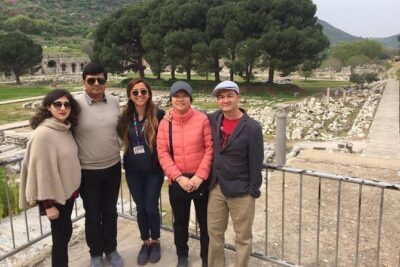
Ephesus, Just Your Party
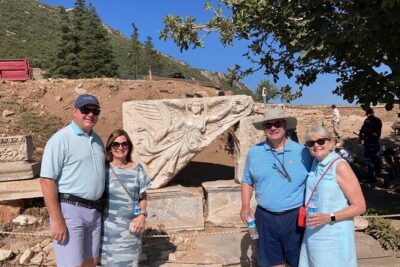
Up to the House of the Virgin Mary
The Last Column of Artemis
Just Added Around Kusadasi
- Ephesus and House of Mary from Kusadasi Cruise Port★ 4.0 · 3 reviews
- Ephesus: 4-Hour Guided Tour with Transfer from Kusadasi★ 5.0 · 3 reviews
- Sirince Village & Selcuk Bazaar Tour From Kusadasi★ 4.5 · 3 reviews
- FOR CRUISERS: Best of Ephesus Tour with GUARANTEED ON-TIME RETURN★ 5.0 · 3 reviews
- Shore Excursion: Private Pamukkale Tour From Kusadasi Port★ 5.0 · 3 reviews
- For Cruisers: Ancient Ephesus Private Tour From Kusadasi Port★ 5.0 · 3 reviews
House of the Virgin Mary Tours, compared.
 ★ 5.0Top Choice For Cruisers: Ephesus, Mary’s House WITH TICKETS+LUNCHFrom $297,233 reviews
 ★ 5.0PRIVATE NO HIDDEN FEES Ephesus, Mary’s House Guided Tour /GRP OPTFrom $992,455 reviews
 ★ 5.0ALL INCLUDED: Ephesus Ruins, Mary’s House Tour incl ENTRY TICKETSFrom $591,670 reviews
 ★ 5.0Ephesus Temple of Artemis and House of Mary Private Half Day TourFrom $151,573 reviews
 ★ 5.0PRIVATE TOUR FOR CRUISERS: Mary’s House (Meryemana) and EphesusFrom $291,349 reviews
 ★ 4.8Ephesus: Mary’s House and Artemis Tour with Entry TicketsFrom $35945 reviews
 ★ 5.0ALL INCLUSIVE Private Ephesus, House of Virgin Mary with lunchFrom $169819 reviews
 ★ 5.0ALL INCLUSIVE Private Ephesus, House of Mary, LUNCH, EntrancesFrom $134735 reviews
Browse the lists this tour appears in