
Review · EPHESUS PRIVATE GUIDED TOURS
Kusadasi Port Private Ephesus Tour with LUNCH
Ephesus feels way more manageable with a private plan. This Kusadasi Port tour pairs a private guide with a smooth air-conditioned round trip, so you spend your time walking the right streets instead of figuring them out. I especially like having a private guide for your group of up to 12, and I like the convenience of door-to-port logistics that fit a cruise day.
One thing to plan for: entrance tickets aren’t included, so budget extra for the site fees before you go.
In This Review
- Key points before you go
- Why this private Ephesus tour from Kusadasi Port makes sense
- Port pickup and getting to the ancient site without stress
- Entering Ephesus through the Upper Gate to Lower Gate walk
- The monuments that matter most: Odeon, Agora, Baths, and Hadrian’s area
- Library of Celsus and the Great Theater: the two-photo combo
- Fountains of Trajan and the Arcadian Way: connecting stories to streets
- The guide’s stories: Alexander, Virgin Mary, and other famous visitors
- Temple of Artemis: short time, big explanation
- Lunch and pacing on a 4-hour cruise-day schedule
- Cost and value: what you pay vs what you’ll still need
- Who should book this private Ephesus tour with lunch?
- Should you book this Kusadasi Port Ephesus tour with lunch?
- FAQ
- How long is the Kusadasi Port Private Ephesus Tour with LUNCH?
- Is pickup and drop-off included?
- Do I need to buy entrance tickets in advance?
- What is included with the tour price?
- Is lunch included?
- What group size is this private tour for?
- What is the cancellation policy?
Key points before you go
- Private guide, group size up to 12: more control over pace and what you focus on.
- Port pickup and drop-off: designed for a shore-excursion schedule from Kusadasi.
- UNESCO Ephesus route with big-name landmarks: Library of Celsus, Great Theater, Agora, and more.
- Temple of Artemis visit: quick stop to understand why it was one of the Seven Wonders.
- Lunch included: you’re not scrambling to find food between ruins.
Why this private Ephesus tour from Kusadasi Port makes sense
Ephesus is famous for a reason. Roman theaters, baths, and temples sit close together, but they cover a lot of ground and the site can feel confusing at first glance. A private guided format helps you get your bearings fast, while still letting you linger where you care most.
For me, the key value here is the mix of guided structure + flexibility. You get a clear route through the major highlights, but you’re not locked into a rigid script. If you want more time around the theater area or you’re curious about specific stories tied to the city, your guide can steer you there.
The other smart part is the timing. You’re doing this as a cruise-day style excursion: pickup at Kusadasi Port, travel by air-conditioned vehicle, then a guided walk through the open-air museum zone, ending back at the port.
Your own guide and car, more private Ephesus days
- FOR CRUISERS: Skip The Lines PRIVATE EPHESUS TOUR &On Time Return
★ 5.0 · 8,527 reviews - PRIVATE EPHESUS TOUR FOR CRUISERS: On-time Return and Skip-Line
★ 5.0 · 5,807 reviews - PRIVATE NO HIDDEN FEES Ephesus, Mary’s House Guided Tour /GRP OPT
★ 5.0 · 2,455 reviews - For Ship Guests:BEST SELLER EPHESUS PRIVATE TOUR & On Time Return
★ 5.0 · 2,029 reviews
Port pickup and getting to the ancient site without stress
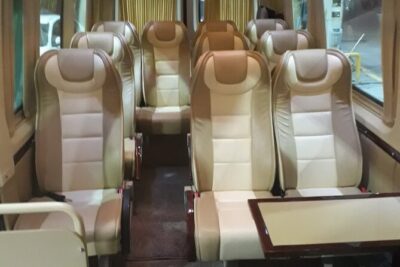
This tour starts with pickup at Kusadasi Port and uses round-trip transfer by air-conditioned vehicle. That sounds basic, but on cruise days it matters. You want to spend less time in transit uncertainty and more time enjoying Ephesus.
As you move toward the archaeological site, you’ll pass remains connected to earlier periods (including Byzantine and Roman archways). It’s a useful lead-in because Ephesus isn’t just one era. It layers centuries of construction and reuse, which becomes clearer once you’re standing in the ruins.
If you’re traveling as a cruise passenger, you’ll provide your ship name plus docking time, disembarkation time, and re-boarding time. That’s exactly what the tour needs to line up the day so you’re not racing the clock at the end.
Entering Ephesus through the Upper Gate to Lower Gate walk
Once you’re in the archaeological area, the tour follows a classic walking flow from the upper gate down toward the lower gate. That approach helps you understand the layout because you’re moving through the main corridors of the city rather than hopping randomly between points.
Your guided time in Ephesus is described as about 3.5 hours total for the tour, with the walking portion covering major sections of the site. Admission tickets are purchased at the gate (so you’re not stuck hunting them down ahead of time). From there, your guide leads you through key landmarks while leaving room to pause and look.
This is the part where a private guide earns their keep. Instead of you trying to piece together what you’re seeing, you’re walking a route with context: where you are, what the building was for, and why it mattered in the city’s life.
The monuments that matter most: Odeon, Agora, Baths, and Hadrian’s area
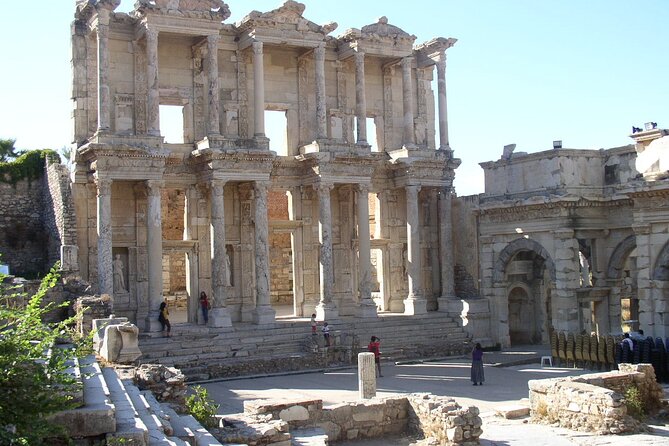
Ephesus has a lot to look at, so you’ll want a strategy. Here’s what you’ll see in this tour sequence, and why each stop earns its spot.
Odeon
You’ll pass the Odeon, a venue tied to performances and public gatherings. It helps set the scene: this wasn’t just a city of temples. It was a working Roman entertainment and public-life hub.
Agora (public life in the open)
The Agora is where Roman public life takes shape. In plain terms: this is the space for civic activity—meeting, speaking, trading, and gathering. It’s a good stop when you want your guide to connect the dots between architecture and day-to-day life.
Scholastic Baths
You’ll also see the Scholastic Baths, a reminder that Roman leisure included daily routines built around bathing. Even if you’re not a “bathhouse person,” it’s a great contrast to the theater and temple areas. You’re seeing how people lived, not only what they worshipped or watched.
Temple of Hadrian and nearby points
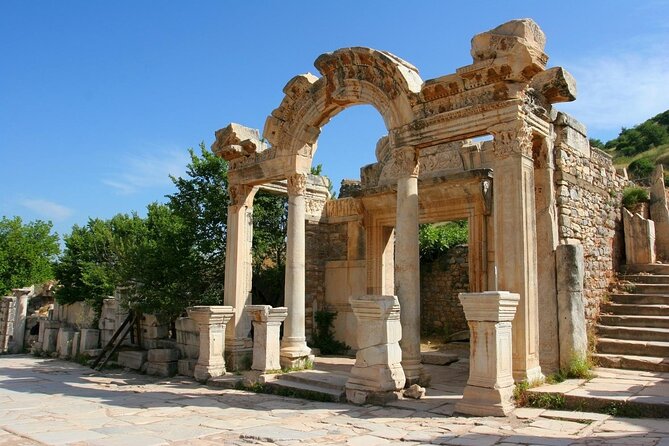
Along the way, you’ll visit the Temple of Hadrian area and nearby points like Domition. These stops are important because they help you understand how different religious and political signals were displayed in stone.
A practical note: Ephesus is outdoors and you’ll be walking between points. Wear shoes you trust, and don’t plan on “just quick photos” at every corner. Pick your moments for pictures and let your eyes do the rest.
Library of Celsus and the Great Theater: the two-photo combo
If you only remembered two landmarks from Ephesus, these are the ones most people build their day around—and this tour makes sure you see both.
Library of Celsus
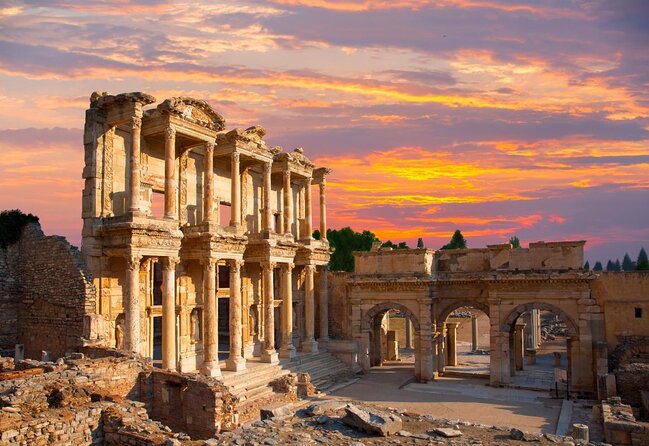
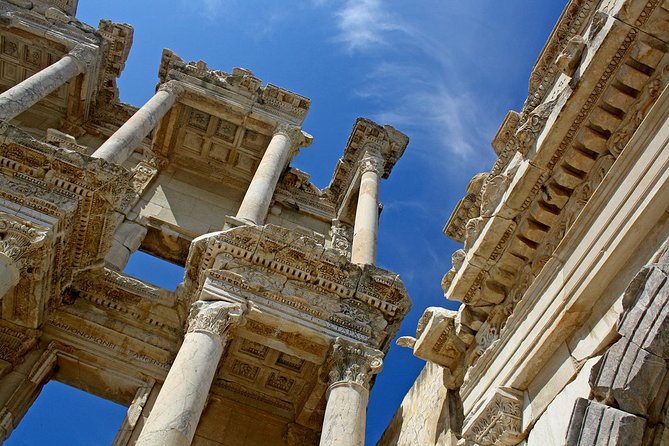
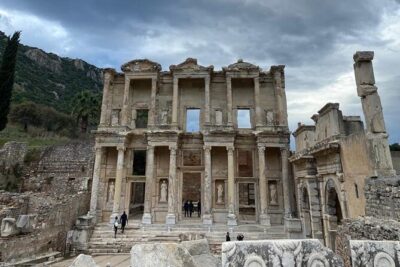
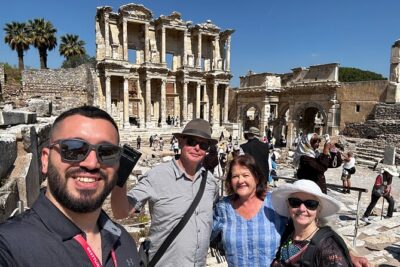
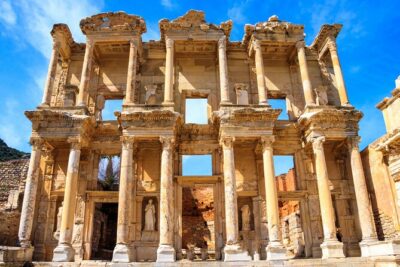
The Library of Celsus is one of the city’s most iconic structures. It’s known as the third-largest library in the ancient world, and seeing it in person helps you grasp why libraries were power centers. This wasn’t just about books. It was about status, learning, and civic pride.
Because the library is visually dramatic, it’s also a great place to slow down and notice details. Don’t rush past it. Even a short pause here gives you a better sense of scale for the rest of the site.
Great Theater
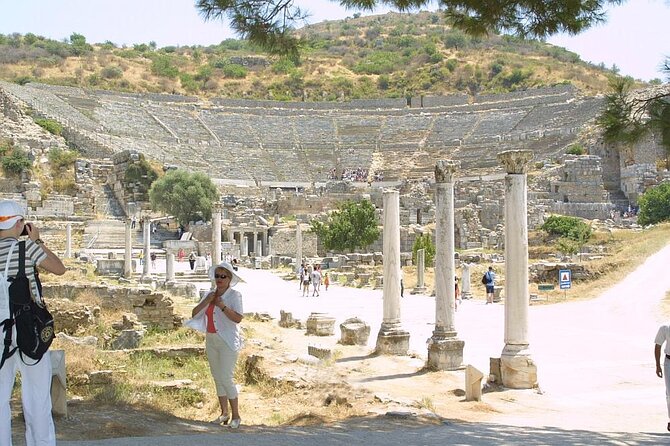
Then there’s the Great Theater, where up to 25,000 ancient spectators could gather for plays, speeches, and gladiatorial combat. One of the best practical aspects of visiting this theater on a guided route is that your guide can explain how performances worked in Roman life and why the theater mattered socially.
And it’s still in use today for concerts, which adds an extra layer to your visit. You’re not only looking at ruins—you’re seeing a space that still performs its original function in a modern way.
More tables set for the midday stop

Fountains of Trajan and the Arcadian Way: connecting stories to streets
Ephesus isn’t only monuments. It’s also the “between” spaces: streets, processional ways, and the routes that connect major areas.
Fountains of Trajan
You’ll also visit the Fountains of Trajan. Fountains in Roman cities weren’t just decoration. They reflected engineering, public utility, and the image of a city able to support large populations and civic spending.
Arcadian Way (Mark Antony and Cleopatra)
The tour includes time walking along the Arcadian Way, described as the route where Mark Antony and Cleopatra rode in procession. Whether you look at that story as literal history or legend, it works as a storytelling device: it helps you imagine how pageantry and power moved through the city.
This is also where your private guide’s interpretation really helps. Instead of you trying to memorize every building name, you’re following a route with meaning, and the city starts feeling like a place rather than a list of ruins.
The guide’s stories: Alexander, Virgin Mary, and other famous visitors
One of the most praised aspects of this tour is the guide quality—communication and a personable approach. In particular, Mr. Umut is named in the available feedback as someone who met as stated and delivered a tour that felt like a favorite day.
That matters because Ephesus can swing between “wow” and “wait, which building is which?” A good guide keeps you oriented and shares stories tied to well-known figures believed to have visited the city during its height—from Alexander the Great to the Virgin Mary, along with other historic characters.
You don’t need to memorize all the stories. The point is that the guide helps you connect the visible ruins to a bigger narrative. That’s what turns a walk through stone into an experience you remember.
Temple of Artemis: short time, big explanation
After your main time in the ancient city, you’ll make a final stop at the Temple of Artemis. The tour gives about 30 minutes here, with the guide explaining why Artemis mattered and what made the temple one of the Seven Wonders of the Ancient World.
What you can realistically expect at this stop is not a whole rebuilt monument. The information provided points to chipped foundations and worn marble columns as the remaining elements. In other words: don’t expect the full grandeur of a fully standing temple. Expect a “read the ruins” kind of visit.
A good way to make the most of the time: focus on your guide’s explanation first, then use the last few minutes to compare what you’re seeing with the idea behind it. That gives the stop meaning instead of feeling like a quick detour.
Lunch and pacing on a 4-hour cruise-day schedule
This is described as a 4-hour tour (approx.) with lunch included. That’s a big deal for value because Ephesus day trips from the port can become expensive fast if you have to buy food separately.
The itinerary flow is built around time pressure without rushing you through the key sights. You’ll do the main walk through Ephesus, then the Artemis stop, and finish back at Kusadasi Port.
If you have food preferences, the data doesn’t specify cuisine or dietary options. So if you have dietary needs, it’s smart to ask the provider directly when you book—especially if drinks or personal expenses are not included (they aren’t).
For pacing, aim to move at a “steady tourist” pace. You’ll see a lot, but with a private guide you can stop when something catches your eye rather than getting yanked forward with a big group.
Cost and value: what you pay vs what you’ll still need
The price listed is $80 per person for a private tour format (group size up to 12) that includes pickup/drop-off, a private guide, air-conditioned vehicle transfer, and lunch.
That price feels like better value than a basic self-guided day when you compare what you get:
- A guide to handle orientation and explanations
- Transportation that fits the port timetable
- Lunch included
- The ability to choose morning or afternoon departure
The cost catch is the entrance fees. The tour data clearly states that entrance fees are not included, and admission tickets are purchased at the gate. Drinks aren’t included either, and there can be parking fees if those apply.
So the smart budgeting move is: treat $80 as the tour package cost, then add a separate estimate for site entrance tickets and any drinks you want.
Who should book this private Ephesus tour with lunch?
This fits best if you want three things at once:
- A guided route through the major Ephesus highlights
- A private-group feel (up to 12)
- A schedule that works from Kusadasi Port
It’s also a good match if you like stories and want context tied to recognizable figures. And if you’re traveling with family or friends who have different interests, a private guide can usually adjust pace better than a rigid group tour.
It may be less ideal if you love total freedom with zero structure. You can still explore Ephesus on your own, but you’d miss the “where to go next” advantage and the guided explanations that make the ruins easier to understand.
Should you book this Kusadasi Port Ephesus tour with lunch?
I’d book it if your priority is a smooth cruise-day plan with a private guide, especially if you want to see Library of Celsus and the Great Theater without spending your vacation time figuring out routes.
Choose it with confidence if:
- You want port pickup/drop-off and air-conditioned comfort
- You value having time to pause for what interests you
- You’re okay budgeting separately for entrance tickets
Skip or reconsider if:
- You’re counting every extra expense and want a totally no-surprises ticket strategy (since entry fees aren’t included)
- You prefer a purely self-guided walk with no guide-led storytelling
If you’re on a first Ephesus visit and you want the day to feel organized rather than frantic, this is the kind of tour that turns “big famous ruins” into a coherent experience.
FAQ
How long is the Kusadasi Port Private Ephesus Tour with LUNCH?
The tour is listed as about 4 hours (approx.). The guided time in Ephesus is described as 3.5 hours, with stops that total around 2 hours in Ephesus plus about 30 minutes at the Temple of Artemis.
Is pickup and drop-off included?
Yes. The tour includes pickup and drop-off at Kusadasi Port.
Do I need to buy entrance tickets in advance?
No. Entrance tickets are not included in the tour price, and the information says you purchase admissions tickets at the gate.
What is included with the tour price?
Included features are pickup and drop-off, a private guide, travel by air-conditioned vehicle, lunch, and a private tour just for your group.
Is lunch included?
Yes, lunch is included.
What group size is this private tour for?
It’s described as a private tour for your group of up to 12 people.
What is the cancellation policy?
This experience is listed as non-refundable and cannot be changed for any reason. If you cancel or amend, the amount you paid is not refunded.
The Midday Table
The Rest of the Shortlist
Ephesus, Just Your Party
Just Added Around Kusadasi
- Ephesus and House of Mary from Kusadasi Cruise Port★ 4.0 · 3 reviews
- Ephesus: 4-Hour Guided Tour with Transfer from Kusadasi★ 5.0 · 3 reviews
- Sirince Village & Selcuk Bazaar Tour From Kusadasi★ 4.5 · 3 reviews
- FOR CRUISERS: Best of Ephesus Tour with GUARANTEED ON-TIME RETURN★ 5.0 · 3 reviews
- Shore Excursion: Private Pamukkale Tour From Kusadasi Port★ 5.0 · 3 reviews
- For Cruisers: Ancient Ephesus Private Tour From Kusadasi Port★ 5.0 · 3 reviews
Ephesus Private Guided Tours, compared.
 ★ 5.0FOR CRUISERS: Skip The Lines PRIVATE EPHESUS TOUR &On Time ReturnFrom $398,527 reviews
 ★ 5.0PRIVATE EPHESUS TOUR FOR CRUISERS: On-time Return and Skip-LineFrom $295,807 reviews
 ★ 5.0PRIVATE NO HIDDEN FEES Ephesus, Mary’s House Guided Tour /GRP OPTFrom $992,455 reviews
 ★ 5.0For Ship Guests:BEST SELLER EPHESUS PRIVATE TOUR & On Time ReturnFrom $392,029 reviews
 ★ 5.0Ephesus Temple of Artemis and House of Mary Private Half Day TourFrom $151,573 reviews
 ★ 5.0PRIVATE TOUR FOR CRUISERS: Mary’s House (Meryemana) and EphesusFrom $291,349 reviews
 ★ 5.0SKIP-THE-LINE: Group & Private Ephesus Tour ENTRY FEE & LUNCHFrom $7935 reviews
 ★ 5.0All Inclusive Private Access Ephesus Tour (SKIP-THE-LINE)From $67843 reviews
Browse the lists this tour appears in